Research
Polymeric materials and structures often undergo large deformation, respond differently at different rates and temperatures, and change with how they are made, used, and recycled. These features make their behavior difficult to predict and to design with. My research lies at the intersection of solid mechanics, polymeric materials, and advanced manufacturing. It establishes predictive relationships among processing, microstructure, time-dependent mechanical behavior, and structural performance, and uses them to design and manufacture polymeric materials and structures for resilient and sustainable engineered systems. The work spans the life cycle of a polymeric part: design and manufacture for a prescribed response, reliable performance over time in service, and recycling into new load-bearing use.
The research is organized in three connected directions. The first provides physics-based constitutive models for families of polymers; the second uses these models to design structures whose response over time is prescribed; and the third links processing, structure, and properties of recycled polymers to guide their manufacturing. Each direction combines experiment, theory, and computation. The experiments include mechanical characterization at large deformation across strain rates and temperatures, supported by dynamic mechanical analysis and digital image correlation, as well as characterization of microstructure and molecular structure by calorimetry, electron microscopy, X-ray scattering, and rheometry. The theory and computation include constitutive modeling, finite-element simulation with user-defined material models, and machine learning. Multimaterial 3D printing produces many of the materials and structures studied. Because it sets the composition, and hence the mechanical behavior, of a material voxel by voxel, the same platform serves to calibrate the models, realize the designs, and test the predictions.
Together, the three directions form a predictive digital twin of polymeric materials and structures. The digital twin supports forward prediction, from processing to structural performance, and inverse design, from a target performance to the structural design, constituent material, and processing route that achieve the target. Measurements on printed and recycled materials and on manufactured structures, in turn, refine the constitutive models. The applications include impact protection, deployable aerospace structures, infrastructure components, biomedical devices, the load-bearing use of recycled plastics, and structures exposed to extreme temperatures, high loading rates, or intense ultraviolet light.
1. Physics-Based Constitutive Discovery
Physics-based constitutive models for entire families of polymers, discovered by combining physical insight with machine learning and validated by high-throughput characterization.
Constitutive models relate the stress in a material to its deformation history, and they underpin finite-element analysis and engineering design. Polymers often undergo large, nonlinear deformation, and their response depends strongly on loading rate and temperature, changes markedly through the glass transition, and evolves with exposure to light, moisture, and other environmental conditions. Models that capture this behavior are typically formulated by experts for one material at a time, through repeated cycles of refinement and calibration, a practice that slows the adoption of new polymers. Data-driven methods promise to accelerate this process, but most have addressed either hyperelastic behavior at large deformation or history-dependent behavior at small strain; the large, rate- and temperature-dependent deformation of polymers in service has received comparatively little attention. Neural-network models also involve many parameters and hyperparameters that have little physical meaning. Because few physical principles are built into them, they often extrapolate poorly beyond their training data and do not reveal the underlying mechanisms; they typically must be retrained for a new material; and evaluating them at every integration point adds cost to large-scale finite-element simulations.
This direction has two parts. The first is a modular library of physics-based constitutive models for polymer families. Each module represents one physical mechanism, such as entropic stretching of the molecular network, intermolecular resistance to yielding in the glassy state, or molecular relaxation by reptation, together with internal variables, such as molecular orientation, crystallinity, and crosslink density, that describe how the microstructure evolves with deformation and environmental exposure. Composition and processing conditions enter the modules as variables, so that one model describes an entire family of polymers at large, nonlinear deformation and across loading rates, temperatures, and environmental conditions. Physical insight is combined with machine learning, including symbolic regression, to identify closed-form expressions for the constitutive relations and for the evolution laws of the internal variables. The resulting models are interpretable and thermodynamically consistent, extrapolate more reliably beyond their calibration data, and are efficient in large-scale finite-element simulation; their modules can be recombined, recalibrated, and transferred to new polymer families.
The second part is high-throughput characterization to calibrate, validate, and refine these models much faster than testing one material at a time allows. Most high-throughput mechanical testing to date has measured a few scalar properties, such as modulus, hardness, or strength. Constitutive models of polymers require more: the full large-deformation response across loading rates, temperatures, and environmental conditions. This direction obtains that response at scale by combining specimen libraries printed with systematically varied composition or processing conditions; specimens designed to capture the response of many compositions in a single test; and automated testing under controlled loading and environmental conditions. Because the data are interpreted directly through physics-based models, they identify which mechanisms a model needs as well as its parameters, and machine learning selects the next most informative experiment.
The long-term goal is an open library with which the constitutive behavior of a new polymer family, or of a known family under new environmental conditions, can be established from a small number of tests. Such a library would shorten the development and qualification of new polymers, enable predictive simulation of polymeric components in protective equipment, aerospace structures, medical devices, and soft robots, including the changes in their behavior with environmental exposure, and supply the material descriptions for the multimaterial designs of the second direction.
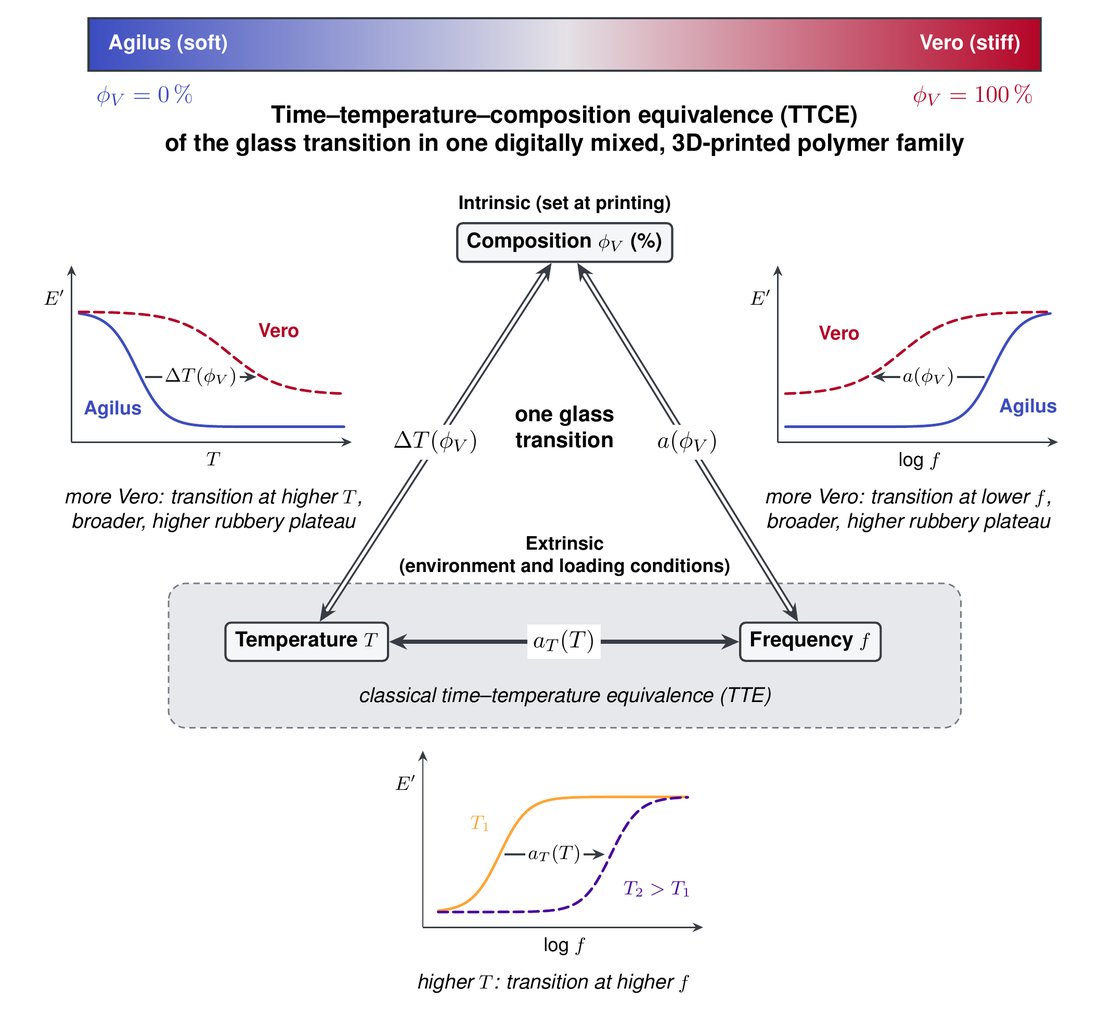
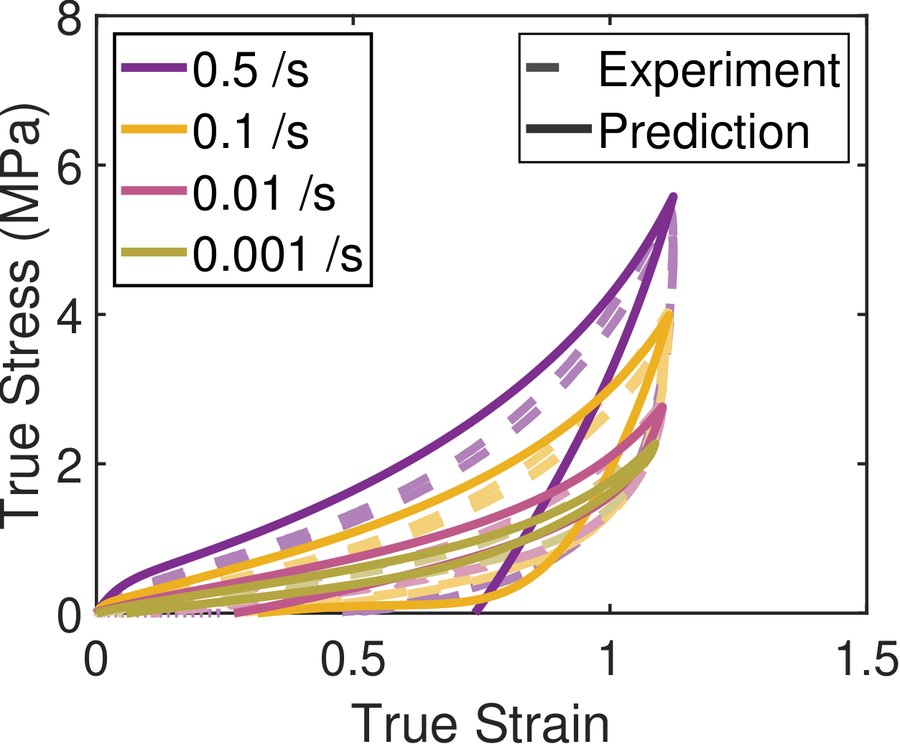
This direction builds primarily on my postdoctoral work on digitally mixed polymers, in which an elastomeric and a glassy photopolymer are mixed voxel by voxel through multimaterial 3D printing. From dynamic mechanical analysis of compositions spanning the family, I extended the classical time–temperature equivalence, a cornerstone of polymer viscoelasticity for seventy years, to a much more general time–temperature–composition equivalence [Shen, Kumar, and Boyce, arXiv 2026]. The storage modulus of every composition, at every temperature and frequency, collapses onto one master curve; the phase angle and the relaxation spectrum superpose in the same way, so the family shares one distribution of relaxation times. A single closed form then gives the stiffness and damping of the entire family across composition, temperature, and frequency. From large-deformation compression tests over three orders of magnitude in strain rate, I formulated a unified finite-strain viscoelastic–viscoplastic constitutive framework for the whole family based on the physical mechanisms of deformation, with material properties that vary with composition according to scaling laws, implemented it for finite-element analysis, and showed that it predicts the response of a composition withheld from calibration [Shen and Boyce, arXiv 2026]. A collaborative study applied data-driven discovery to the same materials [García-Ávila, Shen, et al., arXiv 2026]. These mechanism-based formulations provide the first modules of the library and a basis for extending it to other polymer families.
Relevant Publications
- B. Shen, S. K. Kumar, M. C. Boyce*. Time–temperature–composition equivalence of the viscoelastic behavior through the glass transition of digitally mixed 3D-printed polymers. arXiv:2610.14986 (2026).
- B. Shen, M. C. Boyce*. Composition-dependent nonlinear viscoelastic–viscoplastic behavior and constitutive framework for digitally mixed polymers spanning the glass transition. arXiv:2609.04399 (2026).
- J. García-Ávila, B. Shen, M. Rausch, M. C. Boyce, A. Buganza-Tepole*. Data-driven discovery of composition-dependent constitutive models for hyperelasticity and viscoelasticity of digital materials. arXiv:2609.04541 (2026).
- Z. Wei+, B. Shen+*, Z. Usmanova, U. H. Bootwala, R. Bai*. Thermoviscoelasticity of polydomain liquid crystal elastomers regulated by soft elasticity. arXiv:2605.11455 (2026). (+equal contribution; *co-corresponding authors)
- A. E. H. Chehade, B. Shen, C. M. Yakacki, T. D. Nguyen, S. Govindjee*. Finite element modeling of viscoelastic liquid crystal elastomers. International Journal for Numerical Methods in Engineering, 125(16), e7510 (2024).
2. Spatiotemporal Programming of Structures
Coupling geometric instability with the time scales of the constituent materials, to control how quickly and in what sequence a structure responds to mechanical loads or environmental stimuli and to realize prescribed functions over time.
Architected structures derive functions such as energy absorption, deployment, and shape change from elastic instabilities, such as buckling and snap-through, and from other large, geometrically nonlinear deformations, such as folding. The structural response has time scales of its own, set by the duration of loading and by the speed at which a buckled or snapping region develops. Polymers have intrinsic time scales as well, characterized by relaxation times that are set by the constituent materials and their composition and that change with temperature, stress, and environmental conditions such as light and moisture. Whether a region of a polymeric structure responds in a relaxed, rubbery manner or in an unrelaxed, glassy manner depends on how these two sets of time scales compare, and the comparison can change the mode of deformation, the sequence of instabilities, and the energy dissipated. Most studies of snapping and other instabilities in architected structures nevertheless treat the material as linear elastic or hyperelastic. A smaller number have used viscoelasticity to delay snapping or to produce rate-dependent responses, but principles for designing material and structural time scales together have yet to be established.
This direction designs the two sets of time scales together, so that the speed and sequence of the structural response to a load or to an environmental stimulus, such as heat, light, or moisture, can be prescribed. The work has two parts. The first establishes how geometry converts the relaxation of the material into the timing of structural events, such as the transfer of load between regions, the onset of buckling, and recovery, including delayed and partial recovery. The second uses multimaterial 3D printing to set the relaxation behavior region by region, with the constitutive models of the first direction relating composition to relaxation behavior, so that the material and the geometry of a structure are chosen together. Combining finite-element simulation, machine learning, and experiments, this direction aims at design principles that relate material and structural time scales and at computational design tools that translate a required response over time into the distribution of materials and the geometry of a structure.
Structures designed in this way would enable impact protection for people, vehicles, and equipment with energy absorption tailored to the range of expected impact speeds; deployable aerospace structures that unfold in a prescribed sequence, including after long-term storage; vibration damping over a chosen frequency range; soft robots whose gripping and locomotion are timed by the material; and multifunctional load-bearing structures that dissipate energy or recover their shape, without sensors or active control. Graded polymeric structures with a designed rate-dependent response are also relevant to soft biomedical devices such as implants.
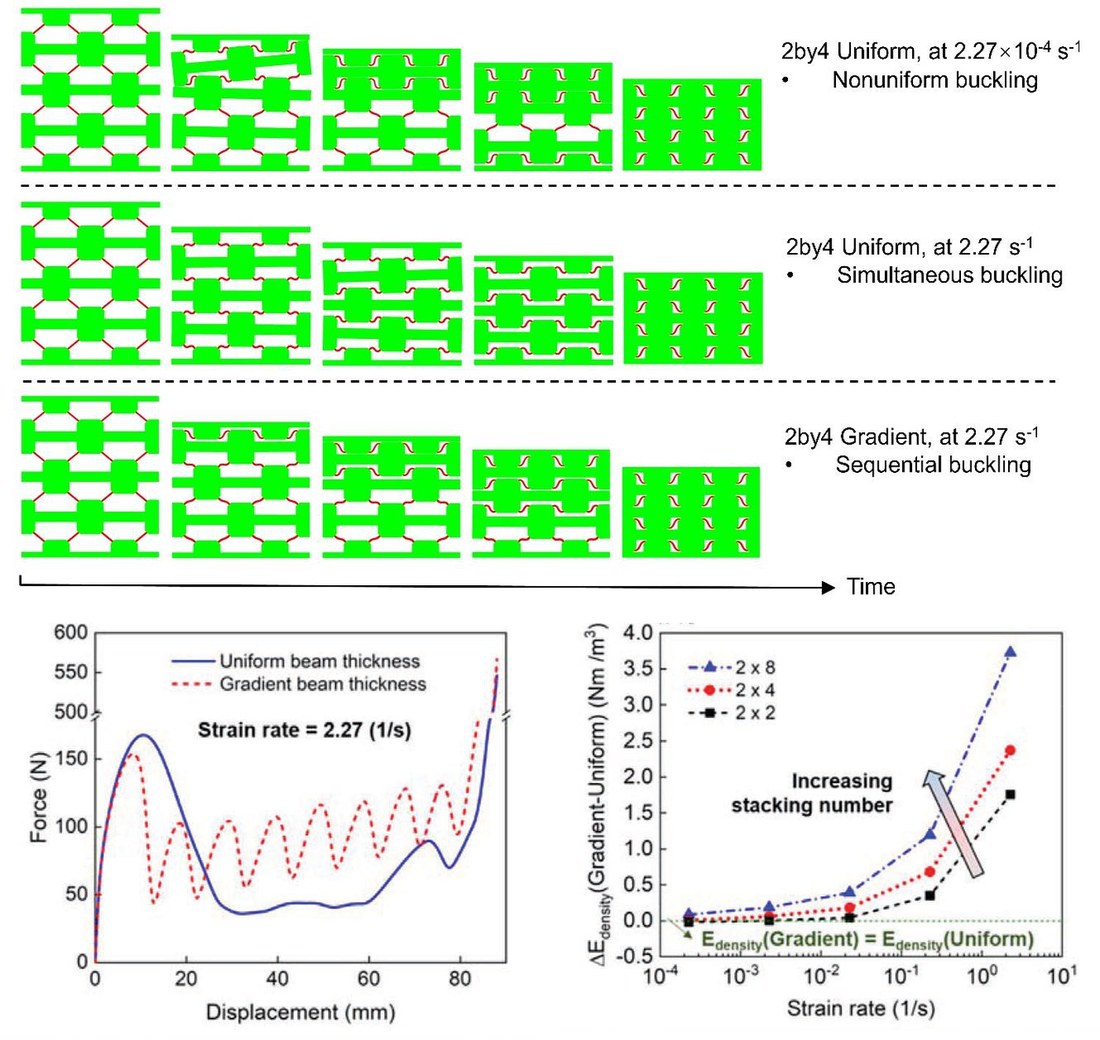
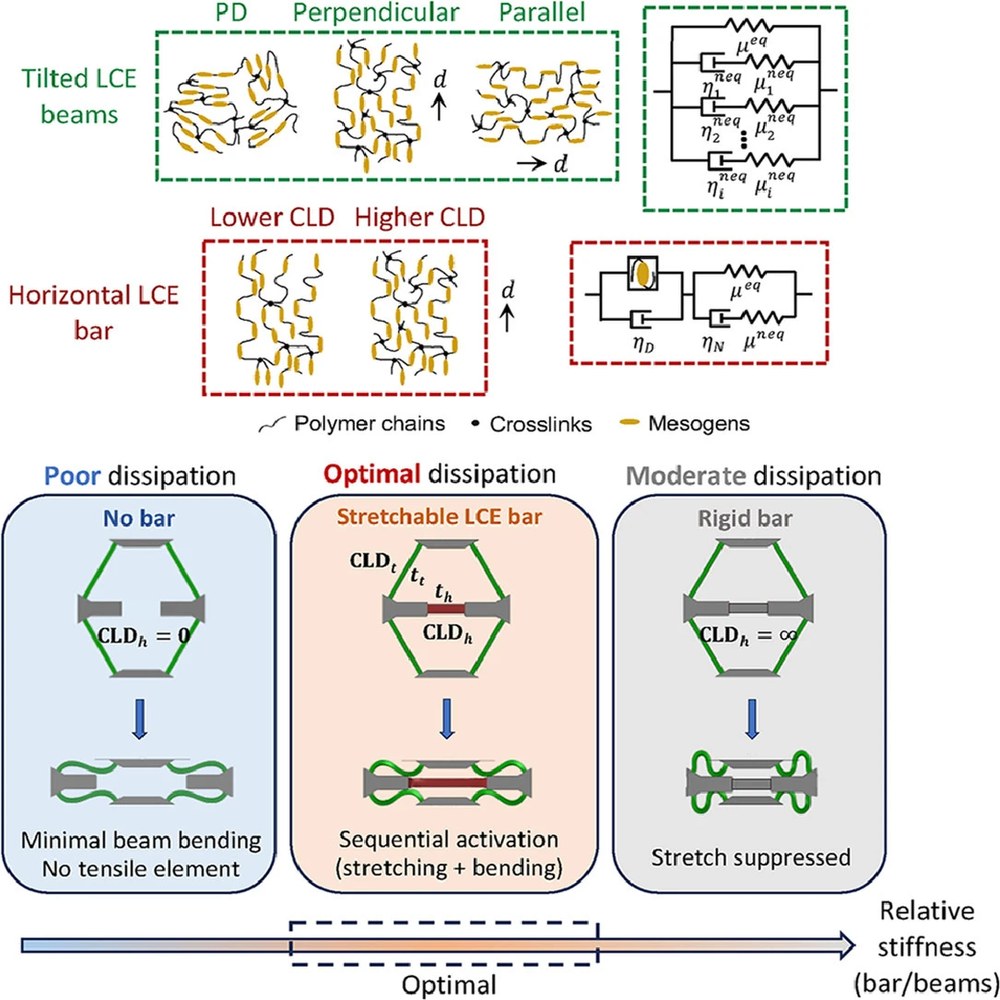
This direction builds primarily on my doctoral research on energy absorption in architected lattices made of liquid crystal elastomers, in which I coupled structural snap-through instabilities with the intrinsic dissipation mechanisms of the material, viscoelasticity and soft elasticity, and studied how to make the two act in synergy. My finite-element simulations showed that viscoelasticity makes stacked layers buckle nonuniformly, with viscous dissipation that grows with strain rate, the number of layers, and graded beam thickness, and that viscoelasticity and snap-through together make buckled layers recover locally and partially, further increasing energy absorption [Jeon, Shen, et al., Adv. Mater. 2022]. Building on this lattice design, I replaced the rigid horizontal member of the unit cell with a stretchable liquid crystal elastomer bar, combining viscoelastic buckling with the tensile soft-elastic response of monodomain liquid crystal elastomers. At an optimal ratio of bar to beam thickness, bending and stretching are activated in sequence, and the lattice absorbs up to 2.5 times the energy of a design with a rigid bar [Shen et al., J. Mech. Phys. Solids 2026]. Competing dissipation mechanisms can thus be nested across the unit-cell and lattice length scales. The underlying principle extends to other lattice architectures: by tuning geometry and material properties, bending and stretching elements can be activated in sequence within unit cells and across layers. In both studies, the gain in energy absorption came from controlling when each mechanism is activated during loading; this direction generalizes that idea to the time scales of materials and structures.
Relevant Publications
- B. Shen*, Y. Jiang, C. M. Yakacki, S. H. Kang*, T. D. Nguyen. Combining stretching-dominated and bending-dominated dissipation behavior to optimize energy absorption in liquid crystal elastomer-based lattice structures. Journal of the Mechanics and Physics of Solids, 209, 106497 (2026).
- N. Hertlein, B. Shen, S. H. Kang, P. R. Buskohl*. Computational analysis of buckling-based stiffness programming of liquid crystal elastomer beams. ASME International Design Engineering Technical Conferences (IDETC), V008T08A040 (2023).
- S.-Y. Jeon+, B. Shen+, N. A. Traugutt, Z. Zhu, L. Fang, C. M. Yakacki, T. D. Nguyen, S. H. Kang*. Synergistic energy absorption mechanisms of architected liquid crystal elastomers. Advanced Materials, 34(14), 2200272 (2022). (+equal contribution)
- B. Shen, S. H. Kang*. Designing self-oscillating matter. Matter, 4(3), 766–769 (2021).
- B. Shen, O. Erol, L. Fang, S. H. Kang*. Programming the time into 3D printing: current advances and future directions in 4D printing. Multifunctional Materials, 3(1), 012001 (2020).
3. Sustainable Manufacturing of Recycled Polymers
The relations among processing, structure, and properties of recycled semicrystalline polymers, established by experiments on a laboratory manufacturing line and by constitutive models, and used to guide and optimize processing.
The microstructure of a polymeric part, and therefore its mechanical behavior, is determined during manufacturing, by the morphology, crystallinity, and molecular orientation that develop during extrusion and molding. For recycled polymers, variability compounds the difficulty. Post-consumer feedstocks differ from batch to batch in composition, contamination, and thermomechanical history, so that polyolefins, the largest-volume plastics, are mostly downcycled into products of lower value. Recent work has made recycled plastics more usable by designing structures that tolerate this variability and by testing them at high throughput; in both approaches, the variability of the feedstock is taken as given. What is still missing is a quantitative link from processing to microstructure to mechanical behavior, with which the process could be chosen to reach a target performance and to reduce variability, instead of being tuned by trial and error.
This direction develops mechanics-guided manufacturing in two steps. The first is understanding: mechanics-based characterization and predictive models that connect melt-processing conditions to microstructure, and microstructure to constitutive behavior, extending the models of the first direction to include microstructural variables such as crystallinity, molecular weight, and the morphology of minor polymer phases and contaminants. Starting with post-consumer polyolefins, these models describe how that morphology governs stiffness, strength, ductility, and anisotropy. The same microstructural variables describe aging in service under heat and ultraviolet light, which alters the molecular structure through chain scission and crosslinking.
The second step is to invert these relations, from a target performance to the process: to choose melt-processing conditions that turn the contaminants of a recycled feedstock into a morphology that preserves ductility. In the same framework, a recycled batch could be qualified from a small set of routine measurements, such as calorimetry, microscopy, and rheometry, and its processing adjusted to that batch.
The long-term goal is manufacturing in which processing is chosen on the basis of predicted mechanical performance, so that plastic waste can be upcycled into load-bearing products, such as automotive, construction, and packaging components, reducing the demand for virgin resin and supporting a more circular plastics economy.
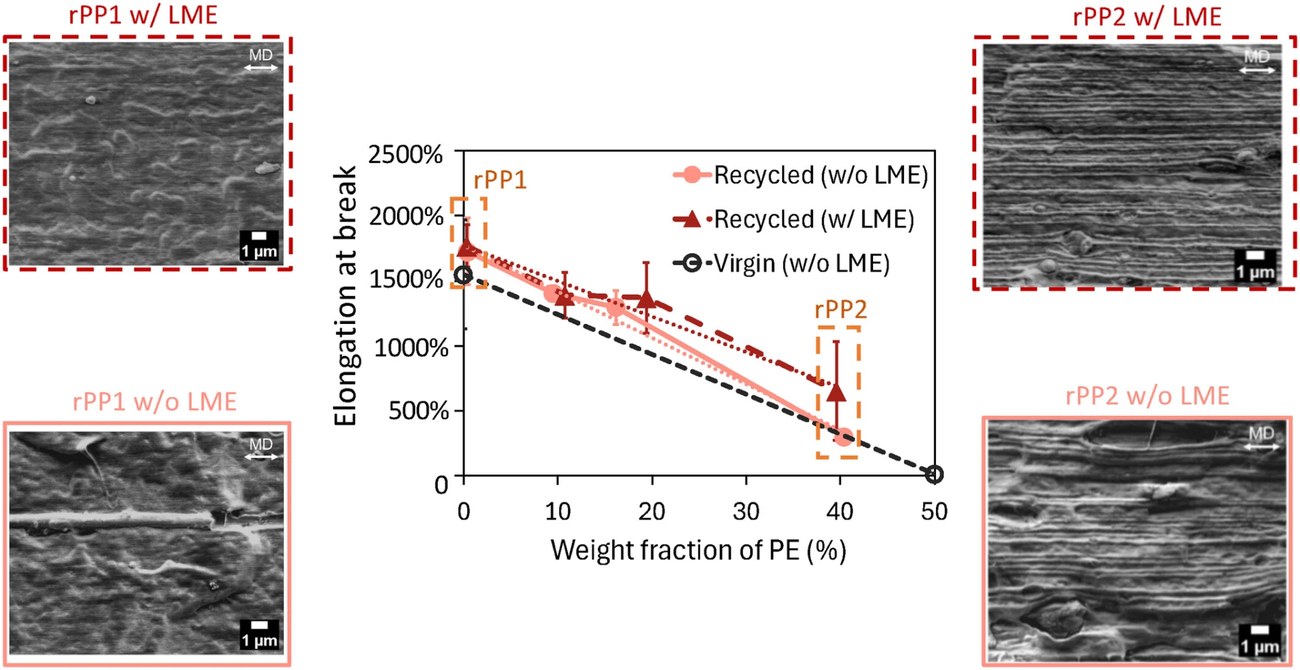
This direction builds on my doctoral research. After helping establish a characterization protocol for industrial recycled polyolefins [Kazmer et al., Polym. Eng. Sci. 2024], I led a study of films extruded from post-consumer polypropylene, using a calorimetry-based method that quantifies the type, fraction, and crystallinity of polyethylene impurities. Combining calorimetry, electron microscopy, rheometry, tensile testing, and X-ray scattering, I showed that polyethylene domains drawn into elongated striations govern the anisotropic ductility of these films: the transverse elongation at break fell from about 1700% to 300% as the polyethylene content rose to 40%. Splitting and restacking the melt with a layer-multiplying element refined the striations, approximately doubled the transverse ductility, and restored the ductility of virgin material with the same polyethylene content [Shen et al., Polym. Eng. Sci. 2026]. These results show that processing can improve a recycled polymer: how it is processed, and not only what it contains, determines its performance.
Relevant Publications
- B. Shen, M. L. Coughlin, S. O. Nzeh, K. B. Migler, D. O. Kazmer, T. D. Nguyen*. The anisotropic structure and mechanical behavior of films extruded from recycled polypropylene. Polymer Engineering & Science, 66(4), 2503–2523 (2026).
- D. O. Kazmer, S. O. Nzeh*, B. Shen, D. C. Elbert, R. Nagarajan, M. Sobkowicz-Kline, T. D. Nguyen. Characterization, processing, and modeling of industrial recycled polyolefins. Polymer Engineering & Science, 64(10), 4801–4815 (2024).